
Kuri Path: A Tour-de-Force of Student to Artisan Relationship

Written by: Adem Çalhanoğlu
Edited by: Thuth Htet San
This past July, I participated in the Kuri Shop, where I got to be an artisan for a day (albeit clumsily) and hear stories from local artisans about their experiences, feelings, and craft. The event was clearly a success in terms of exposing local artisans to the APU campus and its students.
When Kuri Path was announced as their next programme, coinciding with Beppu Art Month this November, I was excited to see the exhibition, the demonstrations, and everything in between. As a journalist for APU Times reporting on the event that Saturday, I have to say it was even more successful than the previous one, and this model will surely continue to thrive.
Under the unusually hot and humid air of early November, I arrived early to find the square in front of Tokiwa bustling with preparations. Six booths for different activities were being set up, core leaders rushing back and forth to check progress and consult with other members, and the opening lion dance team in their flamboyant uniforms practising their moves and acrobatics. All this was happening at 11 am, which felt far too early, so I ate lunch.
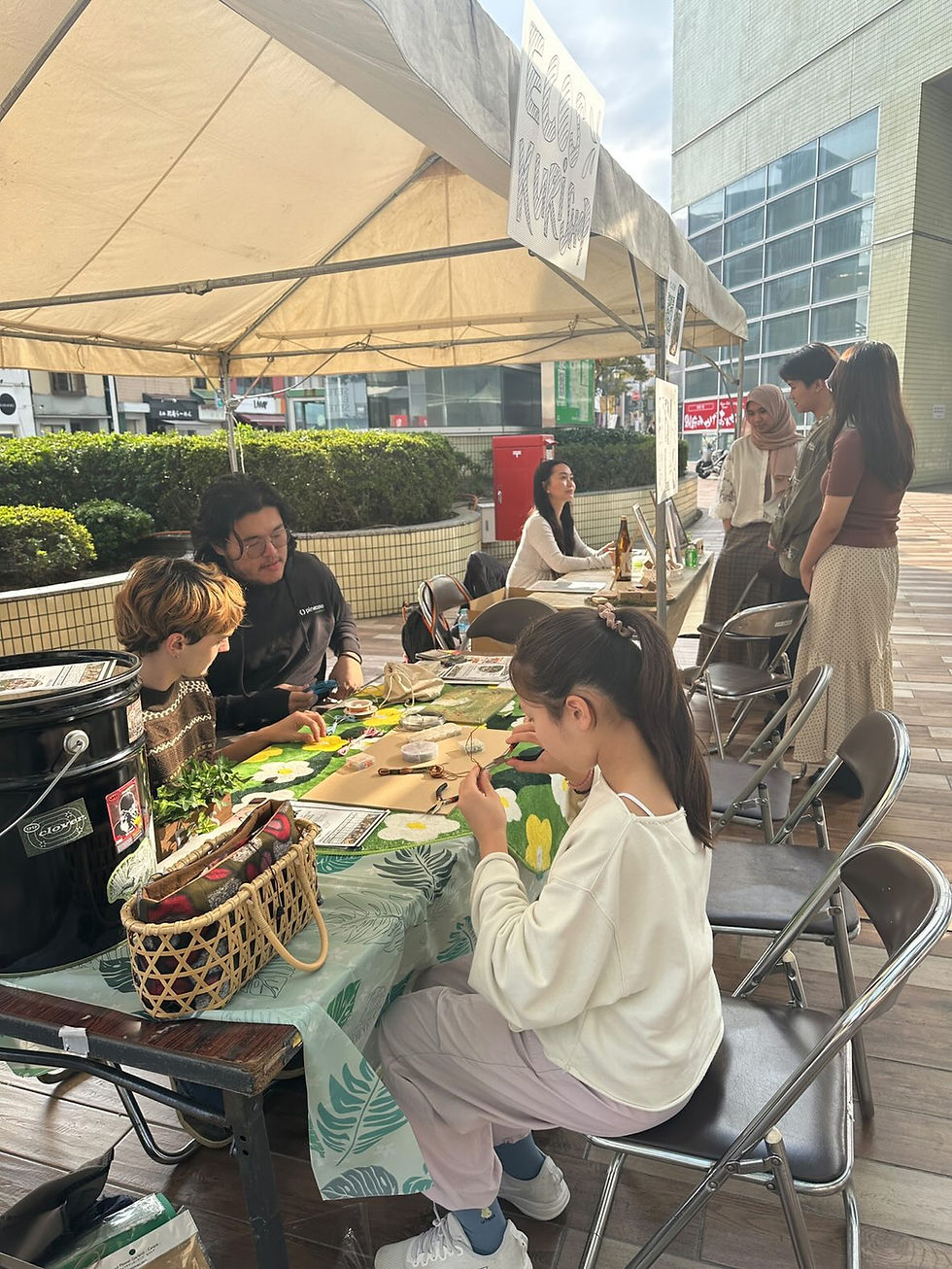
By the time I finished, three-quarters of an hour had passed and they still hadn’t completed the setup. I thought to myself the event would start at noon sharp, but dear me, I was wrong.
12:30 pm.
Razin and Fahmida would arrive at 1 pm, so I started walking around the booths, taking photos and having quick chats to kill time.
One particular booth belonged to Open Lab, Dr Makino’s seminar, and I spotted Nalu, one of the co-TAs for my MCW class alongside Ryan. We had a catch-up chat and she introduced her product, which was fugu fin (fin from the pufferfish) for soaking in sake as a flavouring. An interesting product, I thought, but since it’s meant for sake and I rarely drink, I politely left the box for a more appreciative palate.
Next was Kaneko, a young master calligrapher, then , the APU ECOS booth showcashing upcycled rings and necklaces made from shells, “sea glass,” and plastic collected from their monthly beach clean-ups, while a small art exhibition next to the entrance featured works by my friend Lalain and other Indonesian students. Then I found Watanabe booth with handmade scarves (to be honest I didn’t look closely at this one), and finally the most interesting booth in my opinion, ASOBI. The day before they’d been making these rackets from bamboo called taketto for table tennis, and the place itself was a community centre for handicrafts and DIY projects.
The opening ceremony finally began at 12:30 pm with the lion dance. Sure, it paled in comparison to those back home in Vietnam, but it was energetic and fun, and even though I found myself quite close to the performance, I had a good time watching it.
And now for the proper activities.
First I was handed a stamp rally card and told I needed to visit all six booths for a chance to win free merchandise. I started with the calligraphy booth, where they offered to let me write my name on a bamboo piece. I gave it a go and the master seemed impressed at my control. In the end, I paid 500 yen and received Washi (Japanese style paper) with my name written on it, plus a bamboo piece to tie to my backpack, also bearing my name.

Then I walked to the ASOBI workshop, which was an eight-minute walk from Tokiwa. When I arrived, I was out of breath and took five minutes to recover. We played a brief game of table tennis using the improvised taketto, and it was fun despite my terrible performance. I’d played back in my first year and it had been two years since, so the skills were largely forgotten.
For the rest of the event, I went to the remaining booths to collect my stamps. When I’d gathered them all, I approached Fathiya, who told me there would be a raffle for the free merchandise. However, since I was the first person to collect all the stamps, I got to choose my prize without entering the raffle. I selected a lovely postcard as a souvenir from the event.
It was now 2:15 pm. Tired and hungry, I conducted the interview with Fathiya. She discussed how she, Nash, and their team had formed the club following a trip to Miyazaki and a conversation with one of the artists at the Beppu Art Fair, who had asked: “Did you do this for a living?”
The artist had replied, “No…., I just want recognition, not only from locals but from people like you, international students or tourists.”

Fathiya went on to mention her uncle, who was an artist in Bandung. She drew a poignant parallel between Beppu and Bandung; both mountain cities with vibrant art communities where artisans struggle for more than just a paycheck. They struggle for visibility. She wants Beppu to gain recognition beyond being just an onsen city and become known as an artsy city as well. We also discussed how difficult it was to communicate with Tokiwa to obtain permission for the event (learning the Japanese way of official communication) and the six months of planning required. I’ve known Fathiya from her time as leader of RITMUNC. She’s diligent, passionate about her work, and always positive. Seven minutes interviewing her was enough to understand her, her work, and her background. At 2:30 pm I headed home.
The exhibition was a success. Nearly a hundred guests, including students, locals, and tourists, visited the booths and had a wonderful time exploring the diversity of Beppu’s art community. To be honest, I had a great time myself, even though I was rather tired after the walk up to the station. It got me thinking about something we’d discussed in my practicum class this semester regarding the future of the geothermal sources that make the onsen possible. As these resources eventually run out, what will Beppu have in its arsenal to attract tourists? There are many possibilities, but in my opinion, art and crafts could serve as an excellent alternative. Here’s to more Kuri events, should they continue next semester or year.


Comments